
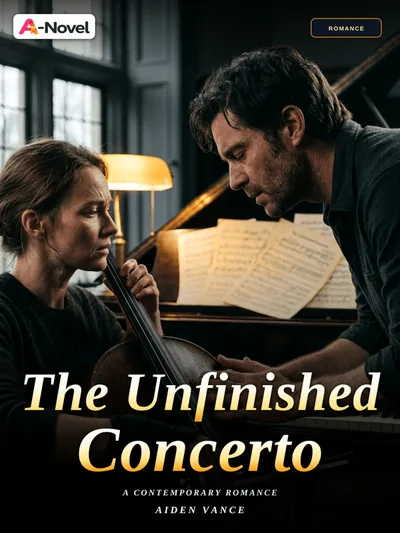
The salt spray hit the cracked leather of Clara’s boots before she even cleared the stone pillars.
A nor’easter was tearing off the Atlantic, whipping freezing rain across the granite bluffs with the force of shattered glass. Her umbrella had inverted and snapped two miles back on the access road, its warped steel ribs abandoned in the trunk of the hired town car that had flatly refused to climb the private drive. She dragged the fiberglass cello flight case behind her, wheels rattling brutally over wet slate and pine needles, each vibration traveling up her wrist like an electric shock.
Under her left arm, pressed tight against the soaked wool of her trench coat, rested the water-resistant leather portfolio containing Arthur Sterling’s final bequest.
Five years. Five years of clean, sterile practice rooms at the New England Conservatory, five years of pretending that a severed tendon and a broken heart were merely logistical setbacks, and now the estate lawyers had dragged her to the edge of the continent to hand-deliver thirty pages of legal spite.
Clara mounted the porch steps. Her knuckles, red and numb with cold, struck the wrought-iron knocker twice.
The sound echoed through the hollow belly of the house. No footsteps answered, but the heavy oak door gave way with an ominous click, already unlatched against the draft.
“Julian?” Her voice was swallowed by the roar of the surf below.
She pushed inside. Clara set her cello case down against the paneling, unbuttoned her drenched coat, and took a measured, stabilizing breath.
She followed the trail of low light down the central corridor, past towering oil portraits darkened by centuries of soot, toward the conservatory.
He was standing by the floor-to-ceiling glass where the storm raged against the black pane.
In his left hand, he held a tumbler of amber liquid, untouched. His right hand remained submerged deep inside the pocket of his trousers.
He didn’t turn around when the floorboards groaned under her weight.
“The gate was locked,” he said. “A sensible person would have turned the car around at Rockland.”
“The driver did,” Clara said, stepping into the perimeter of the amber lamp. “I walked the last half mile. Arthur’s executors don’t accept weather as an excuse for probate delays.”
Julian slowly turned his head. There was no recognition of their shared past in his gaze—only the cold, defensive assessment of a man being cornered in his fortress.
“Arthur has been dead six weeks,” Julian murmured, setting the tumbler down on the grand piano beside him. “And he is still sending his favorite pupil to settle his debts.”
“This isn’t a debt, Julian. It’s the Sterling Foundation Trust.” Clara stepped forward, placing the heavy leather folder directly onto the closed lid of the Steinway. “He left eighty million dollars in endowment funds to the symphony and the Blackwood conservatory. The probate court won’t release a dime until you sign the executor release and the residency covenant.”
“Residency covenant.” The corner of Julian’s mouth twitched, a humorless, razor-thin smirk. “He wants me here. In the damp. Where the rot can finish the job.”
“He wanted you to write again.”
“Arthur was a sentimental old fool who mistook a car wreck for tragedy,” Julian said, his voice flat, devoid of self-pity. “And you, Clara, are extraordinarily naive if you think a signature on a dead man’s vanity project changes anything.”
“I don’t care about the vanity project,” Clara countered, her voice hardening, cutting through the low rumble of the distant thunder. “I care about the sixty musicians in Boston whose contracts expire on the first of the month. I won’t bother you again.”
Silence fell over the room, thick and suffocating, punctuated only by the rhythmic lashing of the rain against the glass.
Julian looked at the folder. For a second, his gaze seemed to soften, drawn to the embossed Sterling crest on the leather, but the wall snapped back into place instantly. He took two slow, deliberate steps toward her.
He stopped less than an arm’s length away. At this proximity, she could see the erratic tick of a muscle in his jaw, the faint shadow of stubble, the cold fury vibrating off him like heat from an iron stove.
“You brought the Montagnana,” he said softly, nodding toward the hall where her case stood.
“It doesn’t leave my sight.”
“Does it still have that hollow ring on the C-string?”
Clara’s jaw tightened. “I had the bridge adjusted.”
Julian reached out. He didn’t touch it. Instead, his gaze lifted, locking onto hers with an intensity that made the breath catch in her throat.
“You want my signature, Clara? You want eighty million dollars to save Arthur’s little legacy?”
“It’s your legacy, too.”
“My legacy died on the asphalt five years ago,” he said, the words brutally quiet. “If you want this paper signed tonight, there is a price.”
“State your terms,” she said, refusing to back down, though her fingers dug into the fabric of her damp wool coat to stop them from shaking. “The foundation will meet any reasonable stipend—”
“I don’t want Arthur’s money.” Julian took a slow, deliberate breath, stepping around the piano. “Unpack the cello.”
Clara went rigid. “What?”
“Unpack the cello,” Julian repeated. “The second movement. The one we never finished.”
A cold sweat broke out along the nape of Clara’s neck. “You know I haven’t played that piece since the hospital, Julian. Neither have you.”
“Then the foundation burns,” Julian said calmly, his hand dropping to his side. He turned toward the dark expanse of the glass, the dismissal absolute, ruthless, and final. “Play the opening twenty-four bars. Exactly as we left them. You play them, and I’ll sign whatever Arthur put in that folder. Refuse, and you can walk back down the cliff in the dark.”
