
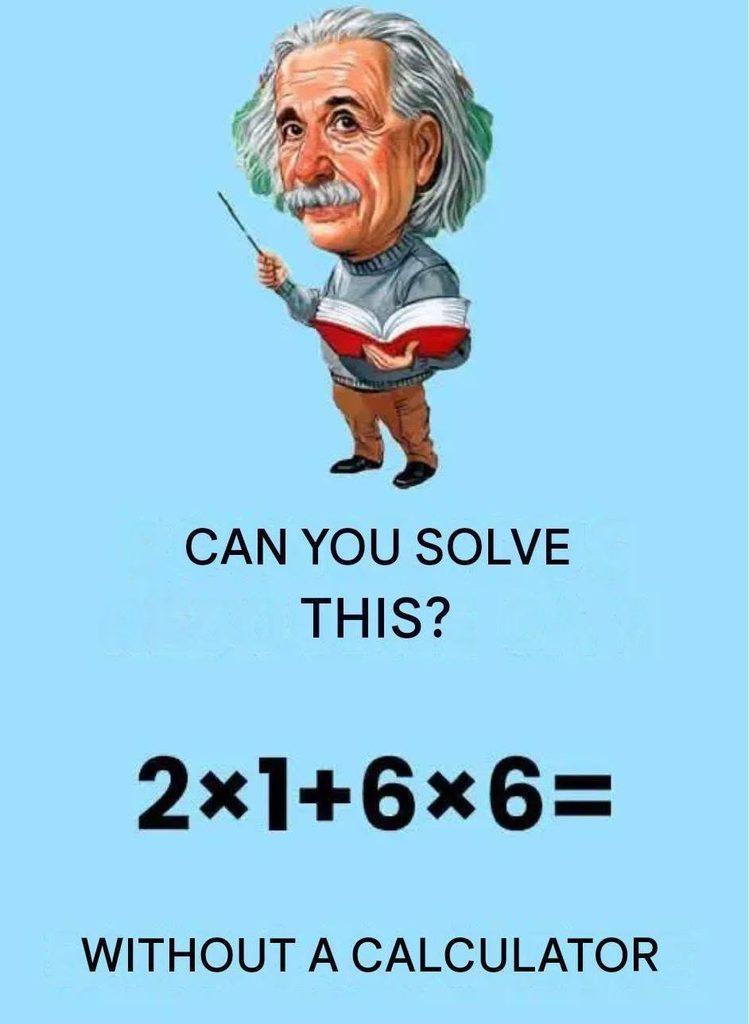
Want to test your mental math skills? This simple-looking equation is a quick challenge that puts your concentration and mastery of arithmetic operations to the test. Shared by Dr. Saba Osmaan on X (formerly Twitter), the puzzle has attracted the attention of many internet users.
The challenge is simple: can you find the correct answer in less than 10 seconds without using a calculator? Although the equation contains only a few numbers and operations, its apparent simplicity can make it surprisingly easy to approach incorrectly.
The Math Challenge
Here is the equation:
2 × 1 + 6 × 6
Before calculating, remember that the order of operations matters. When multiplication and addition appear in the same equation, you should perform the multiplications first and then complete the addition.
For this challenge, give yourself 10 seconds and try to find the answer mentally. Avoid reaching for a calculator, and pay close attention to the sequence in which you perform each operation.
Common Mistakes to Avoid
The main trap in this puzzle is premature addition. If you begin adding numbers before completing the multiplications, you can easily arrive at an incorrect result.
- Ignoring the order of operations: The PEMDAS/BODMAS rule requires multiplication to be completed before addition in this equation.
- Rushing under pressure: Trying to solve the puzzle as quickly as possible can lead to simple arithmetic errors, especially when the equation initially appears easier than it is.
Taking a moment to identify the operations before calculating can help prevent these mistakes. The goal is not simply to answer quickly, but to apply the correct calculation method accurately.
The Step-by-Step Solution
To solve the equation correctly, begin with the multiplication operations, since they have priority over addition.
- Calculate the first multiplication: 2 × 1 = 2.
- Calculate the second multiplication: 6 × 6 = 36.
- Add the two results: 2 + 36 = 38.
The final answer is 38.
If you reached 38 without using a calculator and found the answer within the 10-second challenge, congratulations. The puzzle may look straightforward, but the time pressure and order-of-operations rule are enough to catch people who calculate too quickly.
Why Math Puzzles Go Viral
Can You Solve This Math Puzzle Without a Calculator
Mathematical puzzles are popular because they combine entertainment with a small mental challenge. Solving them can stimulate logical reasoning, concentration, and analytical speed while requiring you to remember and apply calculation rules.
These exercises can also challenge memory by asking you to keep the relevant operations in mind, strengthen concentration by focusing on one task under pressure, and help you become more aware of common calculation mistakes that can occur in everyday life and at work.
This particular puzzle has generated numerous reactions on social media. Some people solved it immediately, while others were caught by the equation’s deceptively simple appearance.
That subtle difficulty is part of what makes these challenges so engaging. They encourage people to test themselves, compare their results with others, and take on another mental calculation challenge.
Ready for the Next Challenge?
The next time you encounter a similar equation, approach it methodically rather than rushing to calculate. First identify the operations that have priority, then complete the remaining calculation in the correct order.
Once you know the rule, a puzzle such as 2 × 1 + 6 × 6 becomes much easier to solve accurately. Share the challenge with your friends and see who can find the correct answer the fastest.
