
Fatigue can influence performance as well. When someone is tired, attention may become less consistent, and it can become harder to maintain a careful search pattern. The same person may solve a puzzle quickly at one time and struggle with it later. That does not mean their intelligence has changed. It simply reflects the fact that visual attention depends on temporary conditions as well as individual habits.
Expectations are another powerful factor. If someone believes the difference must be hidden in the largest object, they may spend too long inspecting that area. Meanwhile, the actual change may be near the edge. Once an expectation forms, people can unconsciously keep searching in ways that support it. A useful strategy is therefore to deliberately check areas that initially seem unimportant.
This effect helps explain why a second person sometimes finds the answer immediately. They may not be more observant overall. Their attention may simply begin in a different place. One viewer notices shape first, another notices color, and another naturally counts repeated objects. Different search habits can produce different speeds even when everyone eventually finds the same answer.
For that reason, spot-the-difference puzzles should not be treated as serious tests of intelligence. Solving one quickly can be satisfying, but performance on a single visual challenge does not measure overall reasoning ability, memory, creativity, education, or personality. These puzzles are better understood as entertainment that encourages focused observation.
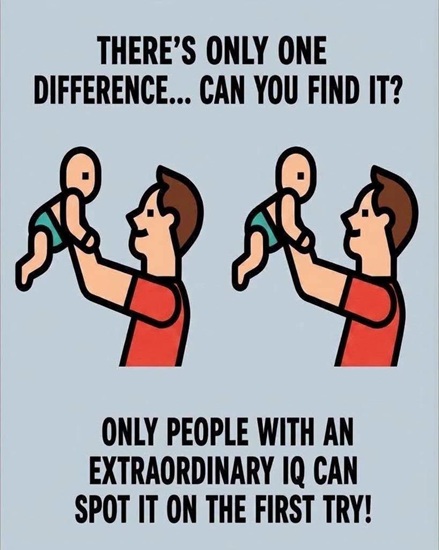
Some online posts attach dramatic claims to visual puzzles, suggesting that finding a difference within a particular number of seconds proves exceptional intelligence or a rare personality type. Such claims should be treated cautiously unless they are supported by validated psychological research. A single recreational image does not provide enough information to diagnose intelligence, emotional health, personality, or hidden motives.
The same caution applies to optical images that claim the first animal, face, or shape a person notices reveals a specific personality trait. These interpretations can be entertaining conversation starters, but they should not be confused with scientifically validated assessment. Human personality is influenced by many factors and cannot reliably be reduced to one visual preference.
A more useful way to approach these puzzles is to treat them as exercises in slowing down. The challenge asks the viewer to resist the natural urge to rely on the first impression. Instead of assuming the pictures are identical because they look similar overall, the viewer has to test that assumption carefully.
That process can be surprisingly enjoyable. At first, the images appear unchanged. The viewer scans them several times and becomes increasingly certain there is nothing different. Then one small detail suddenly stands out. The entire visual interpretation changes in an instant.
Once the difference is noticed, it usually becomes extremely obvious. The changed line, missing object, reversed shape, or altered color seems almost impossible to ignore. Yet moments earlier, the same detail was effectively invisible. This shift illustrates how attention can determine what becomes noticeable even when the visual information itself has not changed.
It also demonstrates that seeing and noticing are not exactly the same thing. A person can technically look directly at an object without consciously registering a small change in it. Attention helps determine which parts of the visual field receive detailed processing.
This is why repeated scanning without a method can be inefficient. The eyes may move across the same locations many times while the brain continues relying on the same overall impression. Changing the strategy can be more useful than simply staring harder.
One technique is to mentally draw a grid across both pictures. Imagine dividing each image into four, six, or nine sections. Compare the same section in each image before moving to the next. This gives the search a clear structure.
Another useful method is to alternate quickly between corresponding objects. Look at one object in the first image, then immediately at the same object in the second. The contrast can sometimes reveal small changes more easily than viewing each image separately for long periods.
If the puzzle contains complicated backgrounds, start with the boundaries. Check corners, edges, frames, rooftops, floor lines, tree branches, and other outlines. Small differences are often easier to hide in areas that viewers assume are merely decorative.
Next, inspect the main subject. Compare facial features, clothing, accessories, hands, feet, hair, buttons, pockets, patterns, and other repeated details. These areas contain many opportunities for a tiny change to blend into the larger design.
After that, examine background objects. Count windows, leaves, clouds, books, lights, or any repeated element. A single missing item can remain unnoticed because the overall pattern still appears complete.
Text and numbers deserve careful inspection too. If a picture includes a clock, sign, calendar, jersey number, label, or other written element, one character may have been altered. The surrounding scene can distract attention from those small differences.
Reflections and shadows can be another source of variation. A shadow may point in a different direction or a reflection may omit an object. Because shadows are often treated as background information, people may not examine them carefully at first.
Perspective can also create misleading impressions. If the two pictures are not perfectly aligned or if one has been slightly cropped, viewers may mistake that shift for an intentional difference. Before deciding on an answer, make sure the difference is part of the illustration rather than simply a formatting change.
When sharing puzzle answers, it is helpful to explain exactly where the difference appears. Saying only “I found it” does not allow others to verify the result. A clear description such as “the third window from the left is missing a line” lets everyone compare the same feature.
If several people produce different answers, they should check whether they are viewing the same version of the image. Viral puzzles are often reposted, resized, compressed, or edited. A version circulating on one page may not be identical to another version elsewhere.
This is especially important when counting puzzles are involved. Small shapes can disappear during compression, and overlapping objects may look different depending on resolution. A disagreement may therefore come from the image rather than from the viewers.
The same principle applies to puzzles that ask how many triangles, squares, animals, or hidden faces appear in an image. A reliable answer should include a method. Counting only the most obvious shapes can miss combinations formed by larger overlapping sections.
A careful solver can write down each shape by size or location. That makes the total easier to verify and reduces accidental double-counting. The process may take longer, but accuracy becomes more important than speed.
This is one reason visual puzzles can be useful as casual attention exercises. They encourage people to check assumptions, organize information, and explain how they reached an answer. These are practical habits even though the puzzle itself remains recreational.
The entertainment value comes partly from the tension between confidence and uncertainty. A viewer may initially feel completely sure that two pictures are identical. After the difference appears, that confidence disappears immediately.
That moment can serve as a simple reminder that first impressions are not always complete. The lesson should not be exaggerated into a claim about every aspect of life, but the underlying idea is straightforward: additional attention can reveal information that an initial glance missed.
Visual puzzles also work well socially because different people naturally use different strategies. One person scans systematically. Another notices color changes quickly. Someone else counts objects. Comparing methods can be more interesting than simply comparing how many seconds each person needed.
Speed should therefore not become the only goal. A slower viewer who finds and explains the correct difference has completed the puzzle just as successfully as someone who noticed it immediately.
Pressure can actually make the task less enjoyable. Countdown claims such as “only geniuses can solve this in seven seconds” are usually marketing devices rather than meaningful psychological standards. There is no universal time limit that determines whether someone is intelligent.
The challenge is better approached casually. Look carefully, experiment with different search methods, and enjoy the moment the hidden detail becomes clear.
For children, such puzzles can also provide a playful opportunity to practice visual comparison. Adults can encourage them to describe what they notice rather than simply guessing. Asking questions such as “What is different about the shapes?” or “Can you count the objects?” can help turn the activity into a structured observation exercise.
For adults, the same basic strategy remains effective. Start broad, then become specific. First understand the overall scene, then deliberately inspect the parts that the first impression ignored.
There is no need to turn the result into a judgment about ability. People differ in eyesight, display conditions, experience with puzzles, and natural attention patterns.
A person wearing glasses may perceive fine details differently from someone viewing the image under ideal conditions. A tired viewer may miss what they would normally notice. Someone using a small screen may face a much harder version of the same challenge.
These practical differences should be considered before making claims about what a person’s answer “means.”
Optical and visual puzzles are most useful when they remain what they are: structured games that encourage observation.
They become less reliable when entertainment claims are presented as medical or psychological facts.
For example, a puzzle should not be used to diagnose attention disorders, memory problems, personality traits, or mental-health conditions.
Professional assessment requires validated methods, broader information, and qualified interpretation.
Likewise, a recreational image cannot determine whether someone has superior intelligence.
A quick answer may simply reflect familiarity with that type of puzzle.
Someone who regularly solves spot-the-difference challenges may learn where designers often hide changes.
Experience can improve search efficiency without implying a permanent difference in intelligence.
That learning process is itself interesting.
After solving several puzzles, viewers often stop staring only at the central subject.
They begin checking corners automatically.
They count repeated objects.
They compare symmetry.
They look for reversed shapes.
Their attention becomes more strategic.
That improvement shows how much problem-solving depends on method.
A person may struggle with the first puzzle and become much faster after understanding how the challenge is constructed.
The improvement comes from changing the search process rather than from suddenly gaining better eyesight.
The same idea explains why hints can be so effective.
A hint such as “look near the bottom left” dramatically narrows the search area.
Another hint such as “check the direction of the objects” changes the feature being examined.
Once attention is guided correctly, the difference may become obvious.
This demonstrates how important selective attention is in visual tasks.
The information may be present the entire time, but the viewer has to direct attention toward the relevant feature.
These puzzles are therefore good examples of why careful inspection can outperform confidence.
The first impression may say everything matches.
A structured comparison may reveal otherwise.
Neither response should be treated as a moral lesson or diagnosis.
It is simply how visual attention can work when two scenes are highly similar.
For anyone struggling with the puzzle, the best advice is straightforward.
Slow down.
Divide the images into sections.
Compare corresponding areas.
Check outlines.
Check colors.
Count repeated objects.
Look at direction.
Inspect spacing.
Examine corners and background details.
Avoid repeatedly staring at the same central object.
And remember that taking longer does not mean failure.
The satisfaction comes from eventually seeing the detail.
Once it appears, the brain usually updates the scene immediately.
The changed feature becomes part of the new interpretation.
From that point onward, it may seem impossible not to see it.
That transformation is one reason spot-the-difference puzzles remain popular.
They create a small but satisfying moment in which uncertainty turns into recognition.
